Wavy Pleated Polishing Wheels: How to Specify Size & Hardness
Wavy Pleated Polishing Wheels: How to Specify Size & Hardness
October 22, 2026
Ло Хайбо является ключевым техническим директором и основным патентным изобретателем в компании Qianma Technology, первоначальном производителе автоматических полировальных машин. Он обладает многолетним практическим опытом в области полировки металлических поверхностей и подбора расходных материалов, возглавляет исследования и разработки в области механических конструкций полировальных машин и оптимизации технологических процессов. Компания Yiliang Polishing (под управлением Guangzhou Yiliang Trading Co., Ltd.), являясь официальным экспортным брендом, предоставляет услуги на мировом рынке и полный ассортимент полировальных расходных материалов. Вместе мы предлагаем комплексные решения по финишной обработке металлических поверхностей напрямую от производителя для клиентов по всему миру.
Луо Хайбо – генеральный директор Yiliang Polishing
Most buyers order a wavy pleated polishing wheel by colour, then discover the size was the problem. The diameter sets the surface speed, the layer count sets the hardness, the centre plate sets the rigidity, and the bore decides whether the wheel runs true or shakes itself apart. This guide covers the seven parameters you actually need to specify — and the two that most purchase orders leave out.
By Yiliang Polishing Engineering Team · October 22, 2026 · 13 min read
Quick Answer
A wavy pleated polishing wheel (also called a pleated cloth wheel or windmill wheel) is a bias-cut cotton cloth wheel with irregular folds clamped around a centre plate. It is specified by seven parameters: outside diameter, layer count, centre plate diameter, bore diameter, cloth colour (which sets hardness), pleat depth, and packing or branding. Our standard range is 8″, 10″, 12″ and 14″ diameter, 16 layers, a 3″/5″/7″ centre plate and a 16–50 mm bore, all of which can be customised; layer count can go up to 26 before the centre clamp can no longer hold the pack. Diameter and spindle speed must be chosen together, because what actually cuts is surface speed, not RPM.
Consumables are the part of a polishing process that gets the least attention and causes the most rework. A machine can be specified to the millimetre and still produce a poor surface if the wheel on the spindle is the wrong diameter for the spindle speed, or too soft for the pressure the machine applies, or bored 2 mm larger than the shaft it is mounted on.
The wavy pleated wheel is unusually sensitive to this, because it is a built-up product: cloth, sizing, pleat, clamp and bore all interact. Change one and the cutting behaviour changes. This guide is written for the person who has to write the purchase order — what each number does, which values are standard, and which combinations cause trouble.
1. What a wavy pleated wheel actually is
A pleated wheel starts as woven cotton cloth, not as an abrasive-coated sheet. The cloth is stiffened with sizing, cut on the bias, stacked into a pack, and clamped around a centre plate. The pack is then opened out so that the layers form irregular folds — the “waves” — rather than lying flat against each other.
That construction is what separates it from the two other cloth wheels on the market. A sewn wheel has its layers stitched together in concentric rings; it is firmer and more predictable, but the stitching limits how much the edge can conform to a shape. A loose, untreated buff is soft and cheap but has little cutting power and a short life. The pleated wheel sits between them: more cutting force than a sewn wheel of the same cloth, more conformability than a stitched pack.
If you are new to the family as a whole, the companion article on air cloth wheels and where they fit in industrial polishing covers the categories. This article assumes you have already decided on a pleated wheel and now have to size it.
One term, several names
Wavy pleated wheel, pleated cloth wheel, air cloth wheel, windmill wheel, folded buff and pleated impeller all describe the same family in different markets. When you request a quotation, send a photograph alongside the dimensions — a name alone will not tell a supplier whether you mean a pleated, sewn or sisal wheel.
2. Why the pleats are not decoration
Three things happen when a pleated wheel spins, and all three come from the folds.
The cloth fibres face outwards. Because the layers are cut on the bias and splayed open, each yarn presents its cut end and its side to the workpiece as the wheel rotates, instead of lying flat against it. The result is a faster, more aggressive cut than a flat pack of the same cloth — the wheel behaves like a very fine, very compliant milling cutter rather than a rubbing pad.
The folds move air. Each pleat acts as a small fan blade. At working speed the wheel pulls air through the pack and across the contact zone, which carries heat away from the workpiece. This is why a pleated wheel can be run dry on stainless steel where a tight sewn wheel of the same hardness would scorch the surface or smear the compound.
The folds hold compound. Polishing wax or paste sits in the valleys between pleats instead of being flung off the rim in the first few seconds. A pleated wheel therefore keeps working longer between applications, and the compound is released progressively rather than all at once.
All three effects depend on the pleat: how deep it is, how many there are, and how evenly they are opened. That is why pleat depth appears in the specification table later, and why a wheel that looks right but has shallow, uneven folds will behave like a much harder wheel than its colour suggests.
3. Six colours, six hardness steps
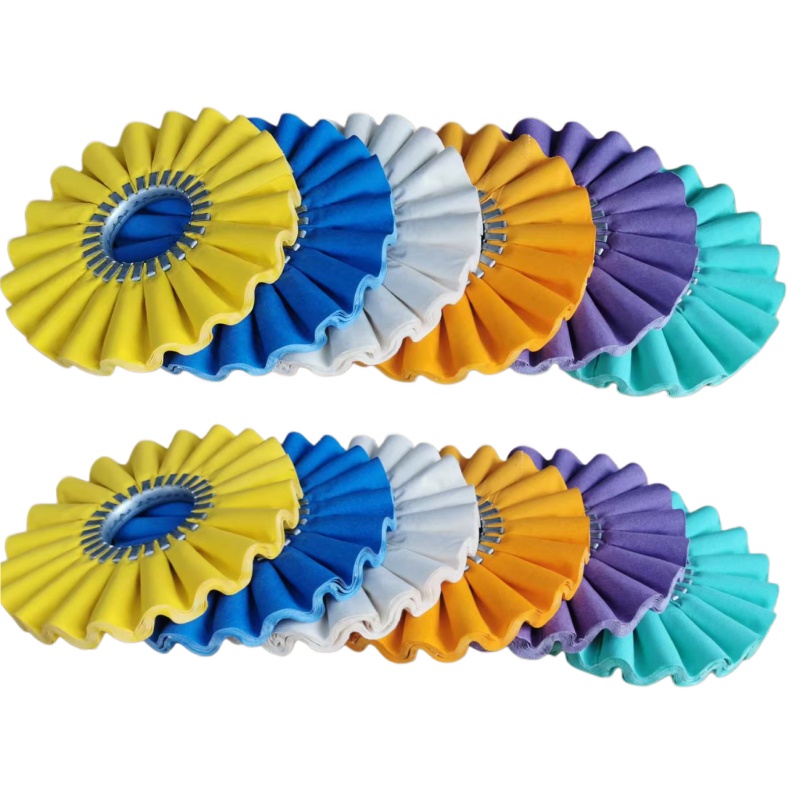
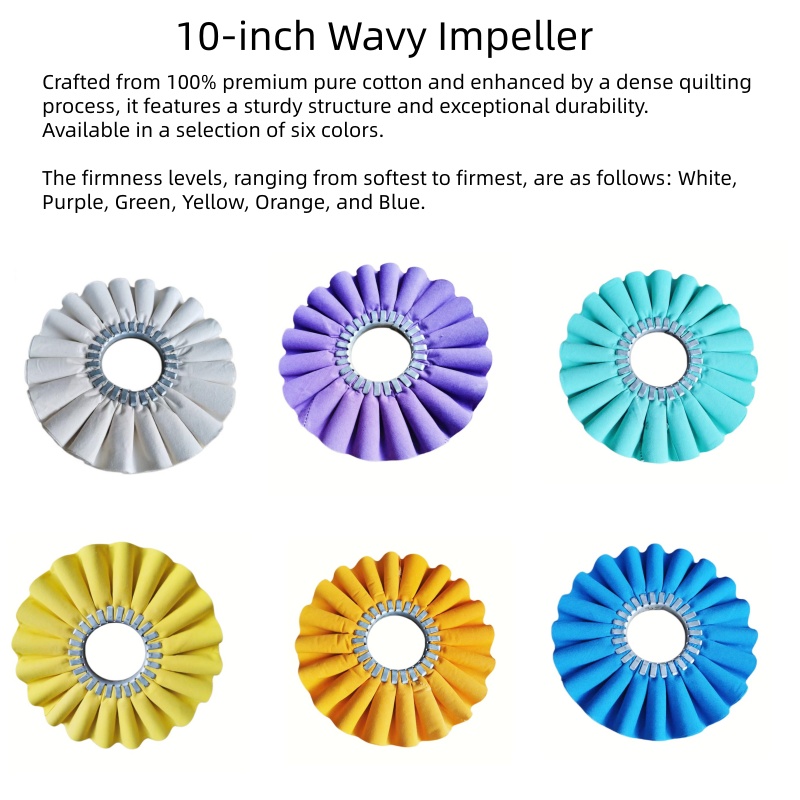
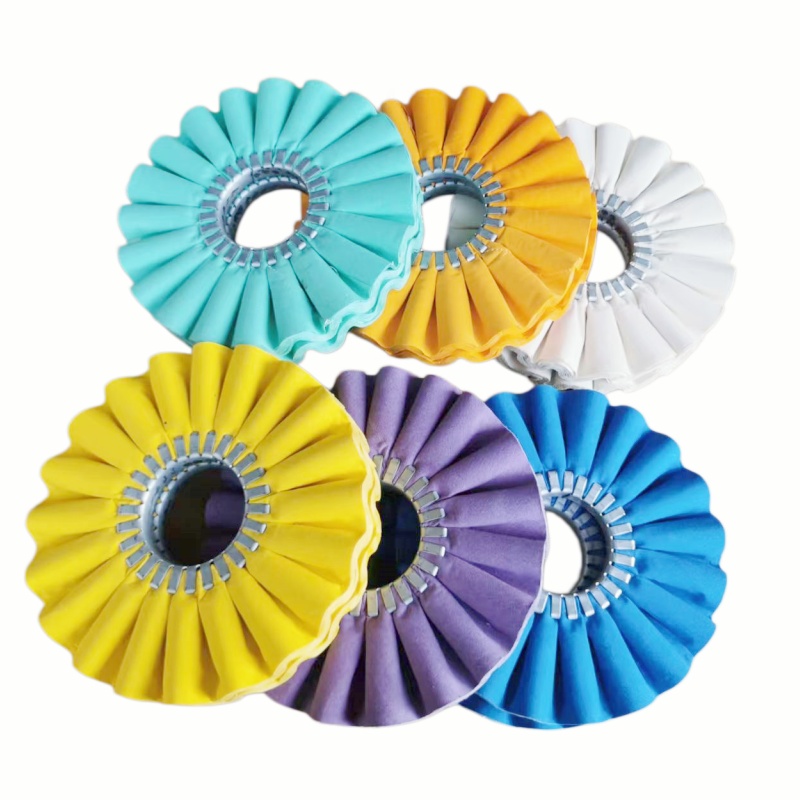
Pleated cloth wheels are colour-coded by hardness, and the colour is a property of the cloth and its treatment rather than a dye added afterwards. Our range runs through six steps, from softest to hardest:
Colour
Hardness
Cutting behaviour
Typical stage
White
Softest
Minimum cut, maximum conformability
Colour finishing, mirror development
Purple
Soft
Light cut, good compound retention
Fine polishing of thin or shaped parts
Green
Medium-soft
General-purpose cut with forgiving pressure
Everyday polishing across mixed work
Yellow
Medium
Balanced cut and finish
Second-stage polishing after deburring
Orange
Medium-hard
Strong cut, holds shape under pressure
Removing scratches and light oxidation
Blue
Hardest
Maximum cutting force, longest life
First-stage cutting on flat surfaces
Harder cloth gives more cutting force and a longer working life; softer cloth gives a better final surface. The trade-off is real — a blue wheel will never produce the finish a white wheel produces, and a white wheel will never remove the material a blue wheel removes.
The practical consequence is that a finishing sequence is usually a colour sequence. A typical three-stage stainless steel process runs blue or orange to remove scratches and oxidation, yellow or green to blend the scratches left by the first stage, then white or purple with a fine compound to develop the mirror. Skipping a step and jumping from blue to white does not save time; it leaves the coarse scratch pattern visible under the fine polish, and the operator compensates by pressing harder, which introduces heat and distortion.
Two rules of thumb are worth remembering. First, match compound coarseness to wheel hardness: a hard wheel with a fine compound wastes the wheel's cutting capacity, and a soft wheel with a coarse compound loads up and smears. Second, never change colour without changing something else — if a white wheel is not removing a defect, the answer is usually the previous stage, not more pressure on the last one. The companion guide to choosing polishing compound for stainless, aluminium and copper covers the wax side of that pairing.
4. The seven parameters to specify
This is the table to work from when you write an enquiry. Everything in the “standard” column is what we hold tooling for and can ship quickly; everything in the “custom” column is made to order.
#
Parameter
Standard
Custom range
What it controls
1
Outside diameter
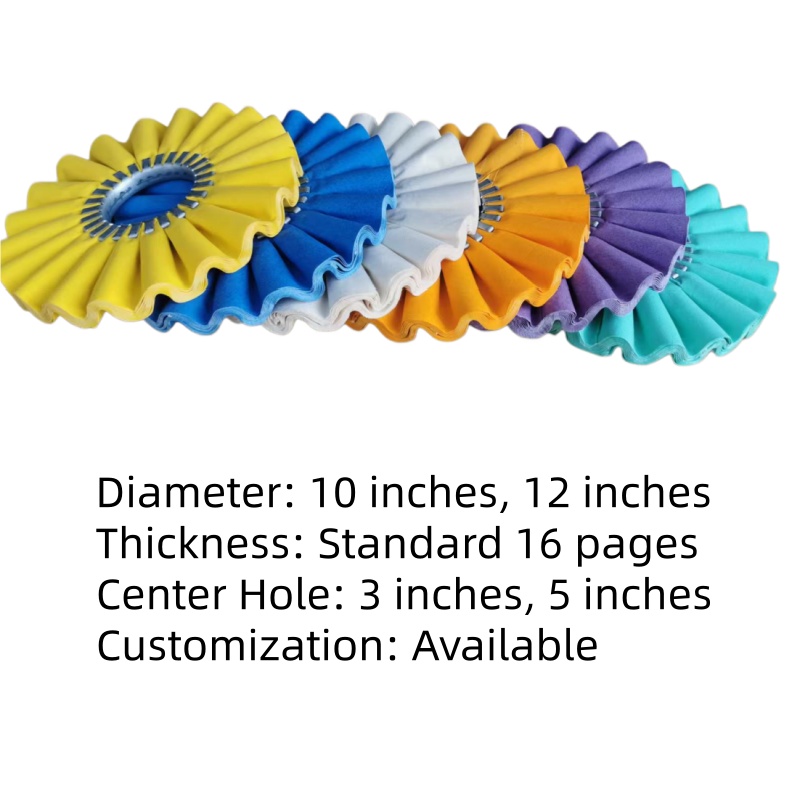
8″, 10″, 12″, 14″
Other diameters to drawing
Surface speed, reach, machine clearance
2
Layer count
16 layers (16P)
Up to 26 layers
Hardness, compound capacity, life
3
Centre plate
3″, 5″, 7″
Matched to diameter
Rigidity, how much the rim can droop
4
Bore diameter
16, 20, 25, 30, 50 mm
To your shaft
Concentricity, vibration, safety
5
Colour / hardness
Six colours
Mixed packs on request
Cutting force and finish
6
Pleat depth
Standard fold
Deeper or shallower
Airflow, softness, surface texture
7
Packing / branding
Carton
Printed carton, label, barcode
Stock handling, private label
Layers are written as “P” in most Asian quotations — 16P means sixteen plies. It is not a grit or a grade number, and a supplier who reads it as one will quote the wrong product.
Note what is not on the list: grit. A cloth wheel has no grit of its own. The abrasive is the compound you apply, and the wheel's job is to carry it, press it against the work and release it at a controlled rate. Buyers who ask for a “400 grit pleated wheel” are usually describing the finish they want, not a wheel specification — tell the supplier the finish and the material, and let the colour and the layer count do the work.
5. How to read a wheel specification
Real quotations are written in shorthand, and the shorthand is where mistakes enter. A line from one of our own orders reads:
D430 × 16P × 7″
D430 — outside diameter 430 mm. Written in metric, even in markets that order in inches, because 430 mm is a round number to a Chinese factory and 17 inches is not.
16P — sixteen layers of cloth in the pack.
7″ — the centre plate diameter, not the bore.
That last point causes more rejected shipments than any other. A 7″ centre plate has a 177.8 mm outside diameter, and the bore through it might be 25 mm, 30 mm or 50 mm. If the purchase order says only “7 inch”, the factory has to guess which of the two dimensions you mean. Always write the plate and the bore as separate numbers, for example D430 × 16P × plate 7″ × bore 30 mm.
The same shorthand appears with different letters in different regions — D, OD or φ for diameter; P, PLY or L for layers; sometimes the plate is called a flange or a core. None of this matters as long as every dimension is labelled unambiguously. What matters is that the bore is never left implicit.
6. Diameter: start from surface speed
Buyers tend to choose diameter by “what fits the machine”, which is necessary but not sufficient. The diameter that matters is the one that produces the right surface speed at the spindle speed you actually run.
Surface speed in surface feet per minute is:
SFPM = π × D (inches) × RPM ÷ 12
Run the numbers across the standard sizes and the reason for the 14″ ceiling becomes obvious:
Diameter
@ 1,800 rpm
@ 2,400 rpm
@ 3,000 rpm
8″ (203 mm)
3,770 SFPM
5,027 SFPM
6,283 SFPM
10″ (254 mm)
4,712 SFPM
6,283 SFPM
7,854 SFPM
12″ (305 mm)
5,655 SFPM
7,540 SFPM
9,425 SFPM
14″ (356 mm)
6,598 SFPM
8,797 SFPM
10,996 SFPM
Cloth wheels generally work best between roughly 5,000 and 9,000 SFPM. Below that the wheel rubs rather than cuts; above it the cloth burns, the compound is thrown off and the wheel can fail.
Two conclusions follow. First, a large wheel does not need a fast spindle: a 14″ wheel at 2,400 rpm is already at 8,800 SFPM, near the top of the useful band, which is why large cloth wheels are normally rated to about 2,400 rpm and no more. Second, a small wheel on a slow spindle may never reach cutting speed at all — an 8″ wheel at 1,800 rpm is below 4,000 SFPM and will polish slowly and heat the part. If your machine runs at a fixed speed, the diameter is not a free choice; it is the value that lands inside the band.
Then check the mechanical envelope, in this order:
Guard or hood clearance. Measure the inside radius, not the opening. A wheel that clears the opening but touches the hood at speed is a burst risk.
Shaft length and flange position. A wider pack moves the working face further out along the spindle; on some machines that puts the wheel outside the guard.
Motor power. A larger diameter with more layers presents a bigger contact area and draws more current. A machine that ran a 10″ wheel comfortably may trip on a 14″ at the same pressure.
Reach versus access. A larger wheel reaches further into a recess but cannot get into a tight corner; many workshops keep two diameters for exactly this reason.
7. Layers: 16 is standard, 26 is the ceiling
Layer count is the parameter buyers most often leave at the default, and it is the one that most directly changes how the wheel feels.
More layers make the pack stiffer. A stiff wheel holds its shape under pressure, cuts faster and lasts longer, because there is more cloth to wear through. It also generates more heat, needs more power, and conforms less to a curved or complicated profile. Fewer layers make the wheel softer and more forgiving: it wraps around an edge instead of cutting it flat, runs cooler, and leaves a finer scratch pattern, but it wears out faster and cannot be pushed hard.
The upper limit is not marketing. It is the centre clamp. The pack is held by a plate and a clamping hub of a given length; beyond roughly 26 layers the clamp cannot compress the stack evenly, the outer layers are held less firmly than the inner ones, and the wheel starts to spread or shed cloth at speed. Twenty-six is therefore a structural ceiling for this construction, not a range we chose to stop at.
Flat surfaces, heavy scratch removal, high pressure
26P (maximum)
Very firm, highest cutting force
Flat plate, first-stage cutting, maximum wheel life
A thicker pack also changes the machine setting: the working face moves, so the tool offset or robot path has to be re-taught when you change layer count.
8. Centre plate and bore: four ways to get it wrong
The centre plate is the steel disc the cloth is clamped around; the bore is the hole through it. Both are frequently underspecified, and both fail loudly.
Bore too large. Even 1–2 mm of clearance lets the wheel sit off-centre. At 2,400 rpm that shows up as a visible wobble and a regular wave in the polished surface — a pattern operators often blame on the machine or on their own hands. It also hammers the shaft and the flange nut.
Bore too small. The wheel will not seat, so it gets forced on, or the bore gets reamed out on site with a drill. Both distort the centre plate, which is the one part of the wheel that has to stay flat.
Plate too small for the diameter. A large wheel on a small plate droops at the rim. The working face is then no longer flat, contact pressure varies across the width of the part, and the finish is uneven in a way no amount of compound will fix. As a rule, larger diameters need larger plates: 3″ for the small sizes, 5″ and 7″ as diameter increases.
No drive feature. Some wheels rely on clamp friction alone. On a machine that reverses, brakes hard, or runs at high torque, that is not enough, and the wheel slips on the shaft. If your spindle has a keyway, a pin or a drive flange, say so in the enquiry.
Measure the shaft, do not read the manual
Machine manuals quote nominal spindle sizes; worn shafts do not match them. Measure the shaft with a caliper at the point where the wheel seats, and note whether it is a plain shaft, a threaded end, or a flanged mount with a key. Send a photograph of the spindle with the old wheel removed. It takes a minute and prevents an entire shipment being unusable.
9. Pleat depth: airflow versus bite
Pleat depth is the least discussed parameter and the one that gives the wheel its character. A deeper, more open fold produces more airflow, a softer contact and a more diffuse scratch pattern. A shallower, tighter fold produces less airflow, a firmer edge and a more defined cut.
The practical effect is on surface texture. Two wheels of the same colour, diameter and layer count but different pleat geometry will not leave the same finish, because the cloth presents to the work differently and the cooling is different. This is why a supplier who changes pleat depth without telling you has effectively changed the product, even though every number on the invoice looks the same.
Use deeper pleats when the part is contoured, when the material is heat-sensitive, or when the finish is the priority. Use shallower pleats when the part is flat, when stock removal matters, or when the wheel has to hold a sharp edge. If you are qualifying a new supplier, ask for samples at the same nominal specification and compare the finish on your own parts — the difference will be visible before it is measurable.
10. Matching colour to workpiece
The colour table earlier describes hardness; this one maps hardness to material. It is a starting point, not a rule — the finish your customer specifies always overrides it.
Workpiece
Start with
Watch for
Stainless steel
Orange or blue, then yellow, then white
Heat tint and smear if the compound is too coarse for the final stage
Aluminium
Green or yellow, softer rather than harder
Loading and galling; aluminium sticks to a hot, hard wheel
Zinc alloy
Purple or green
Edges round over quickly; use light pressure
Titanium
Green, cool running
Local overheating; keep surface speed in the lower half of the band
Plastics and acrylic
White or purple
Melting; reduce speed before increasing pressure
Wood and painted surfaces
White, low speed
Burning through the coating on edges and corners
For mixed work, keep one green wheel as the default and add a hard wheel for stock removal and a white wheel for finishing. Three colours cover most workshops.
Notice that the softer colours appear repeatedly on heat-sensitive and low-hardness materials. That is not a coincidence: the softer cloth both cuts less aggressively and conforms more, so it spreads the contact over a wider area and generates less local heat. When a part is burning, the instinct is to press harder and go faster; the correct response is usually a softer wheel and a slower surface speed.
11. A real order, decoded
To make the shorthand concrete, here is how a recent trial order was specified. A metal products manufacturer in central China ordered two diameters of green pleated wheel to test against their existing supply:
Line
Specification as written
What it means
1
Green wheel D430 × 16P × 7″
430 mm outside diameter, 16 layers, 7″ centre plate
2
Green wheel D440 × 16P × 7″
440 mm outside diameter, same pack and plate
Quantity
8 pcs per size
Trial quantity, not a production run
The 10 mm difference between the two lines is deliberate: the customer wanted to see whether the larger diameter changed the finish on their part before committing to a container order.
Three things about this order are worth copying. First, the customer tested two adjacent diameters rather than one, which is the cheapest way to find the right size on a real workpiece. Second, they specified the colour explicitly, because green was the stage they were trying to improve. Third, the quantity was small enough to be a genuine trial — eight pieces per size is a normal starting point for a custom wheel, and it is how most of our long-term consumable accounts began.
What the order did not specify was the bore. It was resolved by conversation before production, but a purchase order that omits it is one email away from a return. Write it down.
12. What to send for a quotation
A quotation is only as good as the specification behind it. Send these six things and most of the back-and-forth disappears:
1
Outside diameter, in mm or inches
State the unit. If you are replacing an existing wheel, measure the worn diameter and tell us it is worn — a 420 mm measurement on a 430 mm wheel is normal wear, not a custom size.
2
Layer count
If you do not know, say what the wheel has to do and how hard it should feel. 16P is the right default for general work.
3
Centre plate diameter and bore diameter, separately
These are two different numbers and both are needed. Measure the shaft with a caliper and photograph the spindle.
4
Colour, and the stage it is used at
“Blue for first-stage cutting, white for finishing” tells us more than a colour name alone, because it tells us what the wheel has to achieve.
5
Machine and spindle speed
Model number if you have it, plus the RPM you run. We will check the surface speed against the diameter before quoting.
6
Quantity and branding
Trial quantity or production quantity, and whether the carton needs your label, logo or barcode. Private-label packing is available on consumables as well as on machines.
If you can add a photograph of the part and a sample of the finish you are trying to match, the specification almost writes itself. For buyers comparing constructions rather than sizes, the broader guide to choosing a polishing wheel for a given metal finish covers the alternatives, and the full polishing cloth wheel range lists the standard products.
13. Frequently asked questions
What is a wavy pleated polishing wheel?
It is a cotton cloth wheel made by stiffening woven cloth with sizing, cutting it on the bias, stacking the layers and clamping them around a steel centre plate so that the layers form irregular folds. The folds present the cloth fibres outwards for a stronger cut than a flat pack, move air across the work to control temperature, and hold polishing compound in the valleys between pleats. It is also sold as a pleated cloth wheel, air cloth wheel, windmill wheel or folded buff.
Can I order a diameter other than 8, 10, 12 or 14 inch?
Yes. Those four are the standard sizes we hold tooling for, but other diameters are made to order, and metric sizes such as 430 mm and 440 mm are routine in our export orders. Two constraints apply: the centre plate has to be matched to the diameter, and the finished wheel has to fit inside your machine guard with clearance at working speed. Send the diameter you need plus the machine model and we will confirm both.
What do the six colours mean, and which should I start with?
The colour indicates cloth hardness, from softest to hardest: white, purple, green, yellow, orange and blue. Harder cloth cuts faster and lasts longer; softer cloth gives a finer finish and conforms better to shape. For general mixed work, start with green as the default, add orange or blue for first-stage stock removal, and white or purple for the final finish. The colour is a property of the treated cloth, so it cannot be changed without changing the wheel.
How many layers should I order, and is there a maximum?
Sixteen layers is the standard and suits most general polishing. Fewer layers, around 12 to 14, give a softer wheel that runs cooler and conforms to contoured parts. More layers, up to 26, give a firmer wheel with more cutting force and a longer life, which suits flat surfaces and heavy scratch removal. Twenty-six layers is the structural maximum for this construction, because beyond that the centre clamp cannot compress the pack evenly and the outer layers start to spread at speed.
Will the wrong bore size damage my machine?
It can. A bore 1 to 2 mm larger than the shaft lets the wheel sit off-centre, which produces a visible wobble, a regular wave pattern in the polished surface and extra load on the shaft and flange nut. A bore that is too small forces the wheel on and distorts the centre plate. Either way the wheel no longer runs true. Measure the shaft with a caliper at the seating point, note whether the mount is plain, threaded or flanged, and specify the bore as a separate number from the centre plate diameter.
What is the minimum order for a custom size?
Custom diameters, layer counts and bores are made to order rather than held in stock, so the practical minimum is a trial quantity rather than a container. Eight to ten pieces per size is a normal starting point, and it is enough to run the wheel on your own parts and compare the finish against your current supply before committing to production volumes. Mixed packs across colours and sizes can be arranged for a first order.
Send us your spindle, not just a colour
Tell us the diameter you need, the layer count if you know it, the centre plate and bore, the colour and the stage it runs at — plus the machine model and speed. We will check the surface speed, confirm the specification and quote a trial quantity.
Yiliang Polishing · 20+ years in polishing equipment and consumables · Custom sizes & private label supported
YL
Yiliang Polishing Engineering Team Written by the engineers at Guangzhou Qianma Technology Co., Ltd. / Yiliang Polishing — specialists in polishing machines, grinding and finishing lines and consumables, with more than 20 years of industry experience and a decade of export experience across Asia, Europe, Africa and the Americas. www.yl-polishing.com


 Pусский