Stainless Steel Cutlery Polishing: How to Build an Automated Spoon & Fork Polishing Line
Stainless Steel Cutlery Polishing: How to Build an Automated Spoon & Fork Polishing Line
October 26, 2026
Ло Хайбо является ключевым техническим директором и основным патентным изобретателем в компании Qianma Technology, первоначальном производителе автоматических полировальных машин. Он обладает многолетним практическим опытом в области полировки металлических поверхностей и подбора расходных материалов, возглавляет исследования и разработки в области механических конструкций полировальных машин и оптимизации технологических процессов. Компания Yiliang Polishing (под управлением Guangzhou Yiliang Trading Co., Ltd.), являясь официальным экспортным брендом, предоставляет услуги на мировом рынке и полный ассортимент полировальных расходных материалов. Вместе мы предлагаем комплексные решения по финишной обработке металлических поверхностей напрямую от производителя для клиентов по всему миру.
Луо Хайбо – генеральный директор Yiliang Polishing
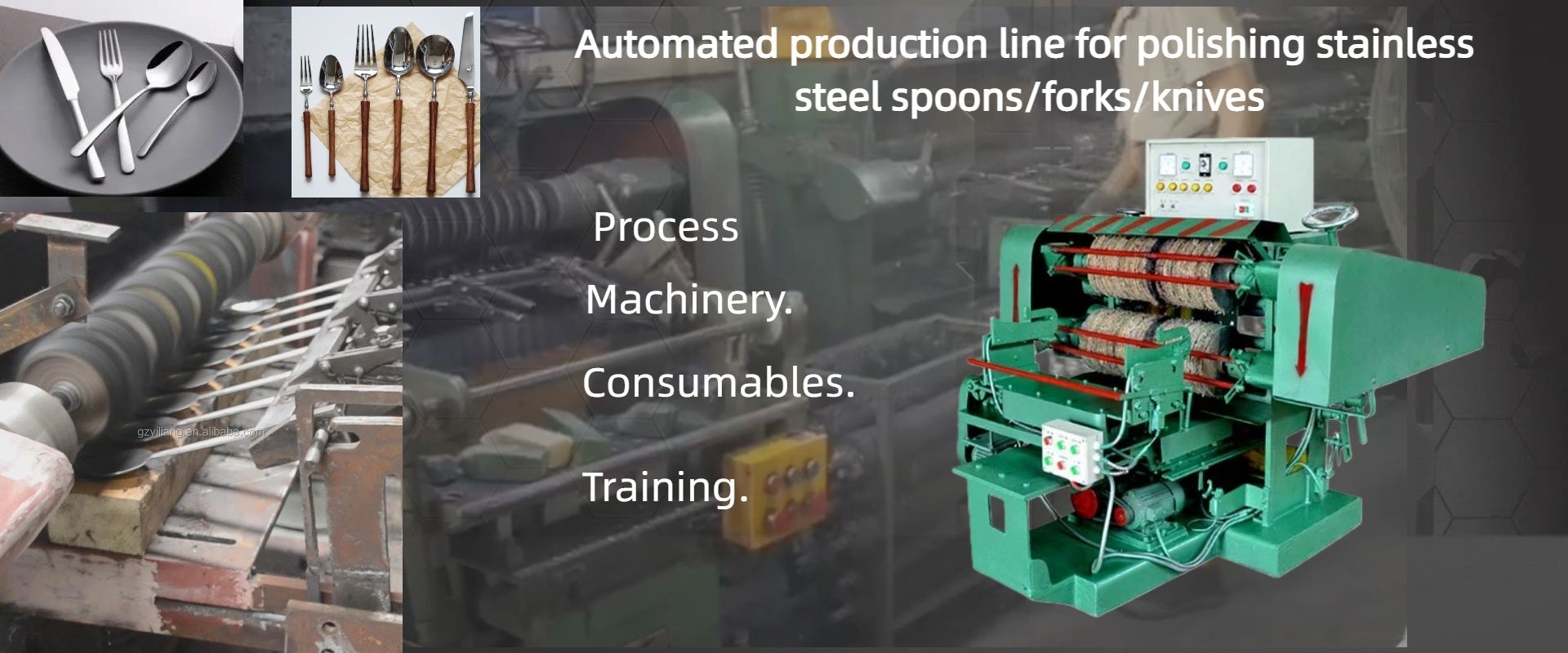
A spoon bowl, a fork's tines and a knife blade each punish a different part of a polishing machine. This guide walks through the full station-by-station cutlery polishing line — built from real project quotations — including the two-stage before/after-forming principle, the four-stage wheel-and-wax recipe, and where robots make sense.
By Yiliang Polishing Engineering Team · Updated October 26, 2026 · 13 min read
Quick Answer
A cutlery polishing machine is not one machine but a line of specialised stations. Because a spoon or fork has a curved bowl, a narrow neck, flat handle faces and (on forks) stamped tines, high-quality lines polish the flat blank before forming, then re-polish the shaped part after molding with curve machines and progressively finer wheels. The finish is built in four consumable stages — sand + sand wax on denim wheels, hemp wheel + purple wax, variegated cloth wheel + green wax, bleached cloth wheel + black bright green wax — and can be fed by a six-joint robot for high-volume plants.
Stainless steel cutlery is one of the most demanding high-volume polishing jobs in the metal-finishing world. A fork that leaves the press looks nothing like the product on a dining table: it carries rolling marks on its faces, extrusion lines along the pressed bowl, burrs between the tines and a dull grey skin from stamping. Turning that blank into a mirror-bright spoon, fork or knife — thousands of times a day, identically — is a systems problem, not a labour problem.
This guide is written from real project files: complete polishing schemes quoted for Indian cutlery plants, a robotic tableware line, and the recurring consumable orders that keep such lines running. If you are planning your first line, or replacing an unpredictable manual workshop with something repeatable, the structure below is the one that has been proven across multiple factories.
1. What a cutlery polishing machine actually is
Definition
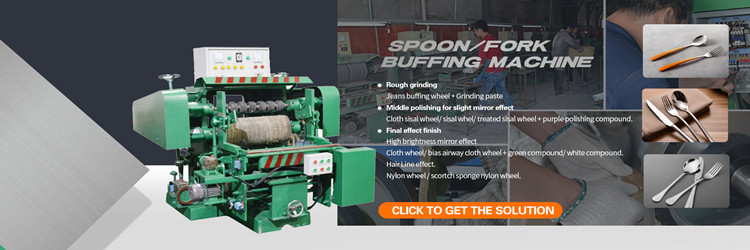
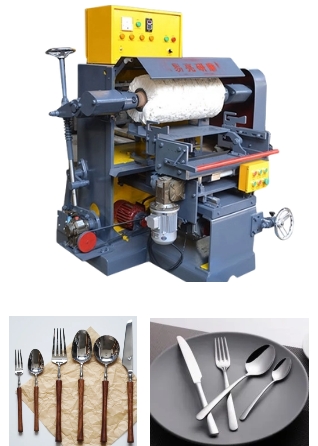
A cutlery polishing machine is a bench-type or automated machine that grinds and brightens stainless steel spoons, forks and knives with rotating wheels or abrasive belts. Because cutlery combines curved, flat and slotted surfaces in one small part, a production line uses a family of specialised machines — horizontal throwers, pneumatic end-arc polishers, single- and double-sided polishers, curve polishers and belt sanders — each dedicated to one geometry, rather than a single universal machine.
Buyers searching for a "spoon polishing machine" or a "fork polishing machine" often expect one machine that does everything. In practice, the question our engineers ask first is not "which machine?" but "which surface?". The bowl of a spoon, the neck where handle meets bowl, the two flat handle faces, the handle edges and the gap between fork tines are five different polishing problems. A competent line assigns each to the machine shape that solves it cheapest and most consistently.
2. Why spoons and forks are harder to polish than they look
A table knife is mostly flat. A spoon is not. Five features of cutlery geometry drive the entire machine selection:
The bowl (double curvature). The pressing operation that forms the bowl leaves extrusion lines on both the inner and outer curve. These need small, soft, arc-shaped wheels that can follow the curve without flattening it.
The neck. The transition from handle to bowl is a tight radius where material piles up during forming. It needs a bidirectional machine that can work the edge from both sides without over-grinding the shoulder.
Flat handle faces. The two large faces need even, full-surface grinding — ideally both faces at once, in a double-sided machine with matched pressure.
Handle edges and the rim. The narrow side surfaces need a dedicated edge-polishing station; if they are skipped, the mirror faces will show a dull outline.
Fork tines. After the tines are punched, burrs and shading sit in the gaps — a place no polishing wheel can reach. Only a narrow abrasive belt can.
On top of geometry, there is volume. A working cutlery plant measures output in tens of thousands of pieces per day, so every station must be loadable in seconds and wear its consumables at a predictable rate. That combination — five geometries, one material, huge volume — is exactly what the machine family below was built around.
3. The two-stage principle: polish before forming, then after molding
The single most important structural decision in a cutlery polishing line is the one buyers usually never think about: part of the polishing happens before the spoon is a spoon.
While the workpiece is still a flat blank, it is easy to clamp, easy to fixture and easy to grind dead-flat. Wide flap wheels (300 mm, 150 grit, in 15/20/30 mm widths) level the faces quickly, and a hemp wheel with purple wax brings the blank to a pre-finish. Once the bowl is pressed, those same faces become double-curved, the blank becomes springy, and the forming operation adds fresh extrusion lines. Any defect left in the flat stage gets pressed permanently into the curve — and shows up as shading that no amount of post-polishing removes.
The rule our process engineers repeat most often
Grind the blank flat and clean before forming; repair the forming marks after molding. The pre-forming stage decides whether a mirror is possible; the post-forming stage decides how bright it is. Plants that skip stage one spend forever chasing shadows in stage two.
Between the two stages sit the forming presses themselves (rolling, pressing, tail molding, trimming and logo embossing, typically 20 T to 500 T presses with dedicated moulds), plus a cleaning machine that removes abrasive residue before the blanks enter the presses — leftover grit at the forming stage is a recipe for press-die damage. A second cleaning and wax-removal stage runs after final polishing, so the cutlery reaches packing free of wax mud and grinding dust.
4. The machine lineup, station by station
The table below is the standard station set for a high-quality small-spoon, fork and knife line. Model numbers are Yi-Liang (YL) series designations used across our quotations; the "surface" column tells you which of the five geometries each station owns.
Station
Machine
Surface it owns
How it works
Pre-forming, flat faces
YL-PM-004
Flat blank faces (handle + bowl area)
Single-head horizontal thrower; wheels turn in one direction; 3 sub-stations with 150# flap wheels 300 mm in 15/20/30 mm widths, then a hemp wheel + purple wax pass
Neck arc
YL-PM-005
Handle–bowl neck, both directions
Double-head horizontal thrower with bidirectional wheels; smooths the neck edge from both sides; 300 mm 7-ply hemp wheel + purple wax
End arcs
YL-ATPM-0031
Both ends of handle/bowl arc
Single-side pneumatic polisher; fixtures are opened (custom-cut) to match each product's end radius; 200 mm denim wheel + sand wax, 100#/150#/240# progression
Rim / edges
YL-ATPM-006
Spoon & fork edges
Single-sided automatic polisher; removes forming marks on the rim; denim wheel + sand wax, then hemp wheel + purple wax
Both large faces
YL-ATPM-007
Front and back faces
Double-sided plane polisher; two wheels polish both faces simultaneously; 200#→240#→280#/320# denim progression, then hemp + purple wax
Outer bowl curve
YL-ATPM-002
Outer curve of bowl
Single-shaft outward-bend polisher; follows the convex curve that forming created
Inner bowl curve
YL-ATPM-001
Inner curve of bowl
Single-shaft inward-bend polisher; small arc-mouth hardened hemp wheels, 70–100 mm dia., 19 mm hex bore
Curve extrusion lines
YL-ATPM-003
Inner + outer curve marks
S-type double-sided polisher carrying two wheel sizes at once (e.g. 100 mm & 250 mm) so bowl curve and neck are serviced in one pass
Fork tine gaps
YL-PM-048
Gaps between fork tines
Fork inner belt sander; 3,500 × 80 mm belt in 100#/150# grinds between the tines where wheels cannot reach
Knife neck / blade
YL-PM-043
Knife neck radius, blade bevels
Multifunctional belt machine; 1,800 × 50 mm belts in 240#/400#/800# for the neck arc and fine blade lines
Cleaning (pre-forming)
Cleaning machine
Whole blank
Removes abrasive residue before presses; uses cleaning fluid / dewaxing agent (25 kg barrels)
Cleaning (final)
Cleaning machine
Finished piece
Removes wax mud and grinding dust after polishing, before packing
Station set from a real high-quality small-spoon/fork/knife scheme; smaller plants start with fewer stations and add as volume grows.
5. A real reference line: scope and indicative pricing
To make the scope concrete, here is what a complete quotation for one buyer's plant looked like — a line covering small spoons, forks and knives at high quality. The figures below are indicative FOB Guangzhou reference prices from a 2023 project quotation, included to help you budget scale, not as a current offer.
Machine
Role in the line
Indicative FOB (USD, 2023 ref.)
YL-PM-004
Single-head horizontal, flat faces
2,950
YL-PM-005
Double-head horizontal, neck arc
3,500
YL-ATPM-0031
Pneumatic end-arc polisher
2,400
YL-ATPM-006
Single-sided automatic, edges
3,100
YL-PM-048
Fork inner belt sander
1,150
YL-ATPM-002
Outward-bend (outer curve) polisher
3,100
YL-ATPM-001
Inward-bend (inner curve) polisher
3,100
YL-ATPM-007
Double-sided plane polisher
3,650
YL-ATPM-003
S-type double-sided curve polisher
3,850
YL-PM-043
Multifunctional belt machine (knives)
1,100
Cleaning machine, pre-forming
Cleaning before presses
13,000
Cleaning machine, after molding
Final cleaning & dewaxing
15,500
Reference quotation, 2023, FOB Huangpu Port, Guangzhou; validity 30 days; T/T 50% deposit / 50% before shipment; delivery 60 days after order. Contact us for a current quotation matched to your product mix.
Two structural notes from the same project. First, fixtures are product-specific: the pneumatic polisher's clamps are cut to match each spoon model's opening, and the inner-curve wheels are sized to the spoon's arc — so a line that must handle several spoon sizes plans for several fixture sets and wheel diameters (70/80/90/100 mm arc-mouth wheels are the common ladder). Second, accessories are reusable: hexagonal spindles (32 mm and 19 mm), backing plates and wheel-assembly tools transfer across machines, which trims the cost of every later expansion.
What a supplier should be quoting besides machines
A serious cutlery-line quotation includes: the fixture list per product, the full consumable starter pack, a plant layout drawing, a dust-extraction design, and commissioning support (engineer dispatch to the customer's factory). If those items are missing, the machines alone will not produce a mirror.
6. The four-stage wheel-and-wax recipe
Every mirror on a stainless steel fork is built by the same four-stage consumable sequence, applied station by station. Each stage erases the scratches of the one before it — this is the same cut-and-colour logic explained in depth in our polishing compound guide, applied to cutlery geometry.
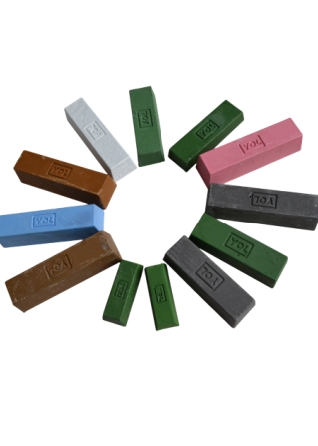
Sand roughening — denim wheel + sand wax
Polishing sand at 100# → 150# → 240# (280#/320# for knives) with sand wax (yellow wax) on a denim (jean) buffing wheel, 150–250 mm dia. × 1 mm, 32 mm hex bore. This does the fast levelling on faces, edges and end arcs.
Medium cutting — hemp wheel + purple wax
A hemp or cloth-sisal wheel (150–300 mm, 5–7 ply) with purple wax removes the sanding scratches and starts the colour. On curves, small hardened pure hemp wheels with arc mouths (70–100 mm, 19 mm hex) follow the bowl without flattening it.
Preliminary polish — variegated cloth wheel + green wax
A variegated (mixed-colour) cloth buckle wheel, 250 mm × 15 pages, centre-stitched, 32 mm hex bore, with ordinary green wax (A4 grade) brings the surface to a uniform pre-mirror gloss.
Mirror — bleached cloth wheel + black bright green wax
The final station runs a bleached cloth wheel, 250 mm × 20 pages (100 mm × 20 pages on the S-machine for curves), with black bright green wax — the highest-gloss, finest-cut compound in the sequence — to deliver the table-ready mirror.
Two consumable details matter more than they seem. First, the sand is applied with cold glue (sand adhered to the denim wheel with adhesive, refreshed as the wheel wears) — this is why denim wheels and glue are always quoted together. Second, the wax set is colour-coded by stage: yellow/sand wax for cutting, purple for medium, green A4 for pre-polish, and the black bright green only at the mirror station, because any earlier use contaminates the finer stages' wheels.
The result of this sequence, run at full station count, is a uniform bright mirror across bowl, neck, faces and edges — the finish grade that export-grade stainless cutlery is sold on. For the underlying theory of cut, gloss and grease, see the compound guide above; for grades and measurement, see our surface finish standards explainer.
7. Forks: tine-gap grinding is a station of its own
Forks add one problem no wheel can solve: the gaps between the tines. After the tine-punching operation, burrs and pressed shading sit inside those slots. A polishing wheel is too wide to enter; forcing it only rounds off the tines.
The answer is a dedicated fork inner belt sander (YL-PM-048): a narrow abrasive belt, 3,500 × 80 mm in 100# and 150# grit, runs through the tine gaps and removes the burrs in one controlled pass. This station sits immediately after tine punching, before the general polishing stages — if the gaps are ground late, the shading inside them has already been polished over and will read as a dark line on the finished fork.
Sequence note from the process files
The process documentation is explicit: if the tine area is not belt-ground first, "a lot of shading will be produced during side polishing." Tine grinding is cheap insurance — the machine is one of the least expensive stations in the line.
8. Knives: blades, necks and the belt-machine workaround
Table knives share the four-stage recipe but stress it differently. The blade's faces may carry a concave–convex grind; the process files flag that where the blade's arc is pronounced, a double-sided plane polisher may not hold the product consistently — the workaround is to run those blades on the multifunctional belt machine (YL-PM-043) instead, using progressively finer belts (240# → 400# → 800# on 1,800 × 50 mm belts) for the neck radius and bevel lines.
The knife sequence in the same project files: coarse sanding at 150#/180#/240# with sand wax on the denim wheel; medium grind with hemp wheel + purple wax; preliminary polish with variegated cloth wheel + A4 green wax; fine polish with bleached cloth wheel + black bright green wax. The stamped logo and handle embossing (typically done on 20 T–700 T presses upstream) should be deburred before the mirror stages, or the embossing's edges will smear.
For shops that also grind kitchen knife blades at higher volumes, we build dedicated knife-grinding machines with automatic left/right and up/down loading — see the knife polishing machine category.
9. Semi-automatic vs robot-fed lines
Every station described so far is operator-loaded: the worker places the blank or semi-finished piece in the fixture, the wheels polish it, the worker moves it on. This is the standard configuration and, in most cutlery-producing regions, the correct economic choice. The next step up is a robot-fed line.
In a robotic tableware line quoted in 2023, a single six-joint general-purpose robot (1,500 mm arm, 20 kg load, 6 kW, 220 V, ~155 kg) with a vertical feeder moved workpieces between nine polishing stations and the cleaning machine; the total for that scope came to roughly USD 45,000 FOB including the cleaning machine and robot, excluding the roughly three-month consumable pack. Automation sizing depends on the plant's conveyor layout and the number of machines, so the robot count is set at the layout stage, not before.
Choose operator-loaded stations when labour is available, product variety is high (many spoon models, frequent fixture changes), and capital is tight. The full machine set above stays flexible and each station can run a different product the same day.
Choose robot feeding when volume is large and stable, the product mix is narrow, and labour cost or availability is the bottleneck. Robots also remove operators from the dust zone, which matters for certification and worker safety.
A middle path many plants take: automate the high-repetition stations first (the double-sided face polisher and the curve machines), keep the specialised stations manual, and let a single robot serve two stations. Our engineers size this per plant; the trade-offs mirror those in our manual-to-automated transition guide.
10. Layout, cleaning and dust extraction
A cutlery line is normally arranged as two floors or two zones: a flat-polishing (pre-forming) zone feeding the presses, and a curve-polishing (post-forming) zone after them, with a cleaning machine at the entry of each. When spoons, forks and knives are produced concurrently, the two-zone layout keeps blanks and semi-finished parts from crossing paths — the most common cause of mixed-finish batches.
Three layout items belong in every plan:
Cleaning before forming. Removes abrasive residue from the blanks so it cannot damage the press dies or press grit into the surface.
Cleaning and dewaxing after polishing. Removes wax mud and grinding residue before packing; the dewaxing agent (e.g. a 25 kg barrel concentrate) is a recurring consumable.
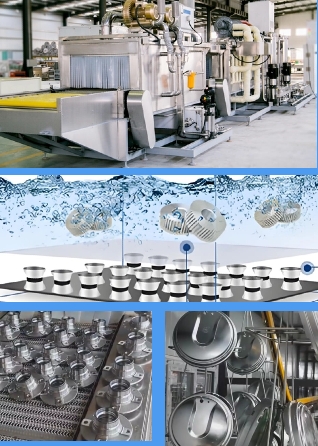
Dust extraction. Polishing stainless steel produces fine metal dust; the extraction system is designed around the plant's footprint and machine positions. For plants with strict fire rules, our combustible dust safety guide covers the risks — and for washdown of oily parts, conveyor-type ultrasonic cleaning machines slot into the same line.
Engineer support is part of every line we ship: on-site commissioning at the customer's factory, operator process training (wheel mounting, sand-and-glue renewal, wax application), and layout drawings sized to the actual building. Delivery for a full line is typically around 60 days after order confirmation.
11. Cutlery consumables — and your own brand on them
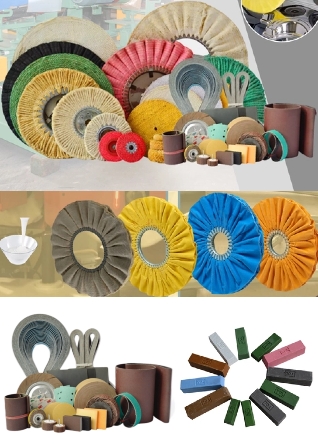
Machines are the one-time investment; consumables are the running cost. A cutlery line consumes, on a roughly three-month cycle: cutlery sisal wheels (80–230 mm dia., 4- or 5-ply, 19/26 mm hex bores), denim buffing wheels, 300 mm flap wheels, arc-mouth hardened hemp wheels, sanding belts, polishing sand, cold glue, and the wax set — sand wax, purple wax, ordinary green wax, black bright green wax — plus dewaxing agent. Consumable starter packs are quoted alongside every line so the plant starts production with matched wheels and waxes, not guesses.
Private Label · OEM · ODM
Put your brand on the consumables your line re-orders every quarter
Cutlery plants buy wheels and wax continuously — which makes the consumable range a natural own-brand programme for distributors and polishing-supply companies, and a cost-controlled direct programme for large cutlery factories.
Custom logo — your mark on the wheels, wax bars and cartons, replacing the standard YL branding
Custom weight & size — wax bar weight and wheel diameter/ply matched to your market's standard
Custom colour & carton — packaging that matches your catalogue
Full-range coverage — OEM/ODM support extends across the consumables line: polishing compound, cloth & sisal wheels, abrasive belts and discs, and polishing brush heads — one supplier, one own-brand programme
~3 monthsTypical consumable pack cycle for a cutlery line
500 pcsMinimum order per model for branded wax — one production run
CustomLogo, weight, colour and carton
Because wheel-and-wax pairing decides the finish, we recommend sourcing machines and matched consumables from one supplier: when a finish drifts, one support channel can diagnose whether the cause is pressure, wheel wear or wax grade, instead of three suppliers pointing at each other. Our full range of wheels lives in the polishing cloth wheel and polishing consumables categories.
12. Frequently asked questions
What is a cutlery polishing machine?
A cutlery polishing machine is a bench or automated machine that grinds and brightens stainless steel spoons, forks and knives. Because cutlery has several very different surfaces — the spoon bowl, the handle neck, the fork tines and the flat handle faces — a production line uses a family of specialised machines (horizontal throwers, pneumatic end-arc polishers, single- and double-sided polishers, curve polishers and belt sanders) rather than one universal machine.
Why are spoons polished before and after forming?
Before forming, the flat blank is easy to hold and every face can be ground flat with wide flap wheels and denim wheels; doing this first removes rolling marks while the metal is still flat. After the bowl is pressed, those flat-ground faces become curved, and new extrusion lines appear on the bowl and neck. A second polishing stage with curve machines and finer wheels then removes the forming marks and builds the mirror. Skipping the pre-forming stage is the most common cause of shading that no amount of post-polishing can remove.
Which wheels and waxes are used for stainless steel cutlery?
The standard four-stage recipe is: (1) sand roughening — polishing sand (100, 150, then 240 grit) with sand wax on a denim buffing wheel; (2) medium cutting — a hemp or sisal wheel with purple wax; (3) preliminary polish — a variegated cloth wheel with ordinary green wax; (4) mirror finish — a bleached cloth wheel with black bright green wax. Small arc-mouth hardened hemp wheels (70–100 mm) are used for the spoon bowl's inner and outer curves.
How many machines does a spoon and fork polishing line need?
A high-quality small-spoon, fork and knife line quoted in a recent project used 20 to 22 machines: fork tine belt sander, single- and double-head horizontal throwers, pneumatic end-arc polishers, single-sided edge polishers, double-sided plane polishers, inward- and outward-bend curve polishers, S-type curve machines, plus cleaning machines before forming and after molding. Smaller shops start with 6–8 machines and add stations as volume grows.
Can a cutlery polishing line be automated with robots?
Yes. A six-joint industrial robot with a 1,500 mm arm and 20 kg load can feed the polishing stations one by one, with vibration feeders and conveyors upstream. In a 2023 robotic tableware quotation, one complete line — nine polishing machines, cleaning machine, robot and conveyor set — was quoted around USD 45,000 FOB Guangzhou, excluding consumables. Robotisation pays off where labour is scarce and orders are large and repeated.
How often do cutlery polishing consumables need repurchasing?
Consumable packs for a cutlery line are sized for roughly three months of continuous production. The recurring items are cutlery sisal wheels (80–230 mm diameter, 4- or 5-ply), denim buffing wheels, flap wheels, arc-mouth hemp wheels, and the wax set: sand wax, purple wax, green wax and black bright green wax. All of these are available under OEM branding, so distributors can put their own logo, weight, colour and carton on the range.
Planning a spoon, fork or knife line?
Send us your product photos, target output and current process. We will return a station-by-station line proposal with fixture list, consumable pack and layout — and, if you want your own brand on the consumables, the OEM options alongside it.
Yi-Liang Polishing · 20+ years in polishing equipment & consumables · Exporting to 60+ countries · OEM/ODM available
YL
Yiliang Polishing Engineering Team Written by the engineers at Guangzhou Qianma Technology Co., Ltd. / Yiliang Polishing — specialists in polishing machines, cutlery and hinge polishing lines and consumables, with more than 20 years of industry experience and a decade of export experience across Asia, Europe, Africa and the Americas. www.yl-polishing.com


 Pусский