How to Choose a Deburring Machine for Laser-Cut Steel Plates (2026 Guide)
How to Choose a Deburring Machine for Laser-Cut Steel Plates (2026 Guide)
October 09, 2026
Ло Хайбо является ключевым техническим директором и основным патентным изобретателем в компании Qianma Technology, первоначальном производителе автоматических полировальных машин. Он обладает многолетним практическим опытом в области полировки металлических поверхностей и подбора расходных материалов, возглавляет исследования и разработки в области механических конструкций полировальных машин и оптимизации технологических процессов. Компания Yiliang Polishing (под управлением Guangzhou Yiliang Trading Co., Ltd.), являясь официальным экспортным брендом, предоставляет услуги на мировом рынке и полный ассортимент полировальных расходных материалов. Вместе мы предлагаем комплексные решения по финишной обработке металлических поверхностей напрямую от производителя для клиентов по всему миру.
Луо Хайбо – генеральный директор Yiliang Polishing
Laser-cut steel plates arrive cheap, accurate and covered in burrs. The question is not whether to deburr them, but which machine configuration does it at your thickness, your edge requirement and your takt time. This guide walks through the five decisions that set the answer — single or double-sided, belts or flap wheels, how many heads, flatness, and feed rate — and shows a real 8-head project as the worked example.
By Yiliang Polishing Engineering Team · October 9, 2026 · 12 min read
Quick Answer
A deburring machine for laser-cut plates is an inline grinding machine that removes burrs, dross and mill scale and leaves a uniform edge or grain, in one pass instead of by hand. Choose the configuration from five variables: (1) one face or both; (2) how much material to remove; (3) the edge finish your customer specifies; (4) the takt time your line needs; (5) the plate thickness, which limits how much pressure you can apply before the part bows. As a rule of thumb, single-sided finishing needs 2–4 heads, double-sided finishing needs heads above and below the conveyor (typically 6–8), and abrasive belts do the removal while flap wheels do the deburring and the grain. A worked example: 300 m/h feed rate with 400 mm part pitch equals roughly 750 deburred plates per hour — the output of about a dozen manual operators.
Laser cutting is a brilliant process with an unglamorous consequence: every cut edge leaves a burr, and every pierce leaves dross. On a bracket, a hinge plate or a mounting plate, those edges then have to be cleaned before the part can be welded, painted, assembled or sold. Multiply that by thousands of parts a week and deburring becomes the bottleneck nobody planned for — a step that is easy to describe, hard to staff, and impossible to make consistent by hand.
This guide is written for the buyer, not the operator: it explains what to look at on your own parts before you talk to any machine supplier, and how each of your answers translates into a machine configuration.
1. What you are actually removing
Definition
A burr is the raised, hardened metal left along a cut edge. Dross or slag is the re-solidified metal clinging to the underside of a thermally cut part. Mill scale is the oxide layer that hot-rolled steel carries on its surface. Edge rounding (or edge breaking) is the deliberate removal of the sharp corner, usually to a small specified radius. All four are normal consequences of cutting steel, and all four are addressed by the same family of machines — but not by the same head type.
What is on the part
Where it sits
Usual treatment
Burr
Along every cut edge, both sides
Flap wheel or brush head; belt at low pressure
Dross / slag
Underside of the cut, at slot and hole edges
Abrasive belt, then flap wheel to blend
Mill scale
Both faces, uneven, dark
Abrasive belt (the only head that removes it quickly)
Sharp edge
Every corner, including slots and holes
Flap wheel or edge-rounding brush, to a specified radius
Scratches / handling marks
Faces
Flap wheel with a finer grit, or a second pass
Identify which of these appear on your parts — that list alone eliminates half the machine options on the market.
If your parts also need a decorative or mirror finish, that is a different job: see surface finish standards explained for how Ra and N-grades translate into process steps, and polishing vs. grinding for where deburring sits in the sequence.
2. Three machines, three different jobs
Search results blur three different machine types into one another, and buyers routinely get quoted for the wrong one. The distinction is worth understanding before you send an enquiry.
Belt sanders (see our automatic belt sander range) remove material fast and flat. They are the right tool for scale, dross and heavy burrs, and the wrong tool for a fine, uniform grain on a light part.
Conveyor-type flat belt sanders (category page) push parts through on a belt — this is the format that suits plates and long flat parts, as opposed to hand-fed or rotary tables.
Flat polishing / deburring machines (category page) combine belt heads with compliant heads such as flap wheels or cloth wheels, in a single line, to finish rather than to cut. Most deburring projects need this combination: cut first, blend second.
The single most common buying mistake
Specifying a belt-only machine for a part that needs a uniform grain, or an all-flap-wheel machine for parts covered in dross. Belts cut but leave marks; flap wheels blend but cannot shift slag. If your parts carry scale and need a consistent appearance, you need both head types — which is why head count, not machine size, is the number that drives the price.
3. The five variables that set the configuration
Every deburring machine we build is defined by the same five answers. Work through them in this order — later answers depend on earlier ones.
#
Question
Why it matters
What it decides
1
One face or both?
A single-sided machine cannot finish the reverse; a second pass doubles handling and cost per part
Whether heads are fitted below the conveyor — the biggest single factor in head count
2
How much material must come off?
Scale, dross and thick burrs need aggressive cutting; paint-ready matte surfaces need almost none
Belt heads vs. flap wheel heads, and how many of each
3
What is your customer's edge spec?
"Deburred", "edge radius 0.5 mm" and "uniform hairline" are three different processes
Compliant heads, grit sequence, oscillation setup
4
What takt time must you hold?
The machine has to keep pace with cutting or punching upstream, not with the finishing bench
Feed rate, conveyor length, number of refinement stages
5
What plate thickness?
Thin plate bows under pressure and heat; thick plate tolerates far more
Question 5 is the one buyers most often forget, and the one that produces the most expensive surprises. A configuration that produces a perfect finish on 6 mm plate can warp 1.5 mm sheet in the same machine. Bring the thickness range, not just the average.
4. How many heads do you need?
Head count is the price driver, so it is worth understanding what each additional head buys. The table below describes the four configurations that cover the overwhelming majority of laser-cut plate work.
Heads
Typical layout
What it delivers
Suits
2
One belt + one flap wheel, single side
Removal and blending, top face only
Light burrs, parts where only the visible face matters
4
Belt + flap wheel top, belt + flap wheel bottom
Both faces finished in one pass, basic grain
Plates needing clean faces and deburred edges, moderate volume
6
As above, plus a second refinement stage on the critical face
Finer, more uniform grain on the face that is seen
Visible or painted parts with a stated appearance requirement
8
Parallel belts and flap wheels plus upper and lower flap wheel stages
Heavy scale and dross removed, both faces with an even hairline grain, slots deburred
High-volume parts with heavy scale on both faces (see the project below)
"Parallel" heads (two wheels running side by side) cover a wider plate without increasing the machine's length, and give a more even result across the width.
Two practical points that are easy to miss. First, head count is not a quality rating — a 4-head machine correctly configured on the right parts beats an 8-head machine set up for a different job. Second, adding a head later is a major rebuild, not an upgrade, so it is worth spending an hour on questions 1–5 before signing rather than a month re-quoting afterwards.
5. Belt heads vs. flap wheel heads
This pairing does the work in almost every plate-deburring line, and understanding it explains why machines are laid out in a sequence at all.
Abrasive belt head
Flap wheel head
Action
Hard, flat, aggressive cutting
Compliant, following the surface
Removes
Mill scale, dross, heavy burrs
Belt marks, fine burrs, edge sharpness
Finish left
Visible belt lines
Even, directional hairline grain
Weakness
Rides over slots and holes; can bow thin plate
Slow to remove scale; loads up on soft metals
Best position
First stage, before anything else
Second stage onwards, including the final grain
Consumable
Abrasive belts (grit set by required removal)
Flap wheels, graded by grit and density
Because a compliant head follows the surface, it reaches the inside of a slot or hole edge that a stiff belt cannot touch. That is the mechanical reason a belt stage must be followed by a flap wheel stage on parts with slots, holes or cut-outs.
6. Keeping thin plates flat
Distortion is the failure mode that costs the most, because it is discovered late — after the parts are finished. Four design choices control it, and all four should be visible in any serious quotation.
1
Pressure control on every head
Automatic pressure compensation keeps contact force constant as the abrasive wears, instead of an operator leaning harder on a tired belt. Uneven pressure is the primary cause of bowed plates.
2
Oscillation, not a fixed track
Heads that oscillate across or along the part spread the contact and the heat over a wider band. The alternative — one fixed track — both forms visible lines and creates local hot spots.
3
Feed rate matched to removal
The same head at the same pressure will warp a part at 100 m/h and leave it flat at 300 m/h. Feed rate is a process setting, not a machine specification.
4
Abrasive grade chosen for the job
Coarser belts remove faster and heat the part more. On thin material, a two-stage approach with a moderate first grit is gentler than one aggressive pass.
This is also where a physical sample matters. A supplier who will not run your part before delivery is asking you to accept this risk on faith — which is why we include an acceptance run on the customer's own workpieces in every custom project.
7. Slots, holes and edge radius
Laser-cut plates are rarely plain rectangles; the slots and holes are usually the reason the part needs deburring at all, and they are where hand grinding is slowest and most inconsistent. Three points decide whether the machine can handle them properly.
Compliant heads are the only reliable answer. A flap wheel or edge-rounding brush follows the contour of a slot; a rigid belt simply spans it. If your parts have many slots or holes, the flap wheel stages are not decoration — they are the function.
Know the edge requirement. "Remove the burr" (no radius), "break the edge" (typically a light radius) and "round the edge to a specified radius" are three different settings. Ask your customer for the drawing callout rather than assuming; the finishing parameter that satisfies a welding shop rarely satisfies a safety-critical assembly.
Do not over-round. The most common quality complaint after machine deburring is the opposite of a burr: edges rounded so heavily that the sharp, crisp corner a product needs has been polished away. Compliant heads remove this risk precisely because they can be controlled, but the pressure setting has to be right.
8. Throughput and payback maths
Feed rate is quoted in metres per hour, but the number that matters is parts per hour. The conversion is simple and worth doing before any quotation discussion.
Worked example
Say the plates are 300 mm long and are placed on the conveyor with a 100 mm gap, giving a 400 mm pitch. At a feed rate of 300 m/h (300,000 mm/h), the machine processes 300,000 ÷ 400 = 750 plates per hour — roughly 12.5 plates per minute, at a quality that does not drift between shifts. Run the same arithmetic with your own part length and gap, not the plate size alone: the gap is part of the decision when parts are fed automatically.
For the manual comparison, a person deburring both faces and the slot edges of a plate of this size typically needs tens of seconds. Multiply that by 750 plates and the arithmetic explains why deburring is usually automated long before the polishing steps are. Our article on the five signs your operation is ready for automation covers the signals that say the same thing on the shop floor.
9. Dust, safety and the dry process
Deburring steel is a dry grinding process, and dry grinding generates fine metal dust and sparks. Two consequences to plan for at specification stage rather than after installation:
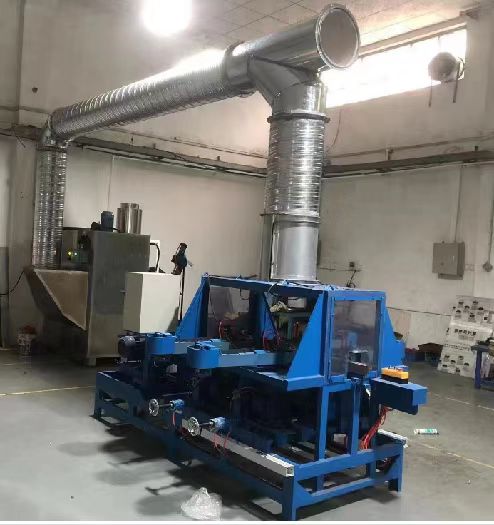
Extraction is part of the machine, not an accessory. Every head needs dust capture at the point of contact, with ducting sized to the head count. A machine sized without extraction will need retrofitting.
Where the dust is combustible, the collector matters. Aluminium and other reactive dusts require an explosion-proof collection system, not a standard bag filter. See our guide to combustible dust safety and the explosion-proof dust collector range.
10. What to send us for an accurate quote
Machine configuration cannot be quoted from a category page. With the following, a proposal and a scheme drawing are usually possible without any back-and-forth — and if you can send physical samples, the proposal becomes far more reliable.
A physical sample part (the single most useful item) — or drawings plus photos of the burr, dross and edges;
Thickness range to be run on the machine, minimum and maximum;
Material — carbon steel, stainless, aluminium, or mixed;
Faces to be finished — one or both, and whether slot and hole edges are included;
Required result — deburred only, edge radius, and any grain or Ra requirement;
Takt time — parts per hour or metres per hour you must sustain;
Part envelope and pitch — length, width and how they will be fed or stacked;
Shop constraints — footprint available, power supply, existing extraction, and whether the machine sits in a line or as a standalone cell.
11. A real project: 8 heads, slotted plates
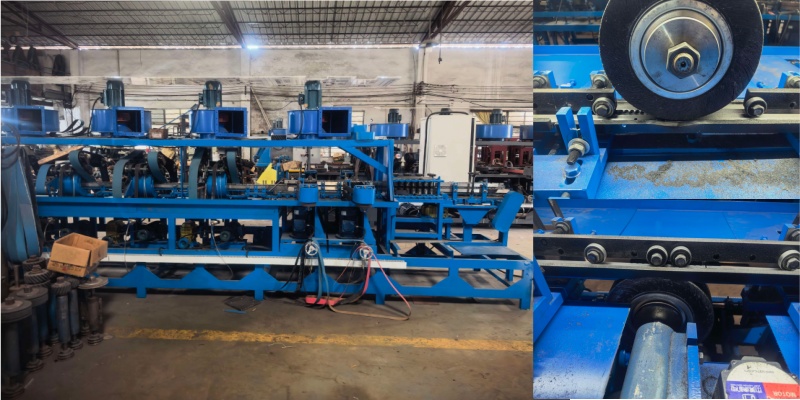
The configuration described above is not theoretical. For a Guangdong manufacturer of structural metal parts, we built an 8-head machine for laser-cut steel plates with oval slots and round holes, finished on both faces. The layout: one set of parallel abrasive belts to remove scale, dross and burrs; one set of parallel flap wheels to blend; then two upper and two lower flap wheels to deliver an even hairline grain on both faces in a single pass — deburred slots, flat plates, no flipping and no manual rework. Design feed rate: 200–400 m/h.
What is the difference between a deburring machine and a belt sander?
A belt sander removes material with one or more abrasive belts and usually works on one face at a time; it is the right tool for scale, dross and heavy burrs, but it leaves visible belt lines. A deburring machine for plates is generally an inline combination: belt heads for removal followed by compliant heads such as flap wheels or brushes that break the edges, blend the belt marks and leave a uniform finish, often on both faces in one pass. If your parts need a consistent appearance rather than just a removed burr, you need the combination, not a belt sander alone.
How many grinding heads do I need for laser-cut plates?
It depends on the workpiece, not on a rule of thumb. Single-sided finishing is typically 2 heads (one belt, one flap wheel); finishing both faces usually starts at 4 heads (belt plus flap wheel above and below); 6 heads adds a second refinement stage on the face that is seen; 8 heads is used where heavy scale and dross must be removed from both faces and an even hairline grain is required, as in our 8-head slotted-plate project. Head count is driven first by one-face-versus-two, then by how much material has to be removed.
Can a deburring machine process both sides of a plate in one pass?
Yes, if the machine is built with grinding heads both above and below the conveyor. Parts then pass through once and come out finished on both faces, with no flipping and no second handling. If the machine only has upper heads, the reverse face needs either a second pass or a separate operation — which is why double-sided finishing is the single biggest factor in head count and machine price.
Will machine deburring distort thin plates?
Not if the machine is configured for the thickness range. Distortion comes from uneven pressure, concentrated heat and excessive removal in one pass. It is controlled by automatic pressure compensation on every head, oscillating heads that spread contact over a wider band, a feed rate matched to the material removal, and an abrasive grade chosen for the plate rather than for maximum cutting speed. This is also why we run a customer's own parts during in-house commissioning and acceptance, rather than approving the machine on demo material.
What edge radius can machine deburring achieve, and how do I specify it?
The machine can be set to break the edge lightly or to produce a more pronounced rounded edge, depending on the head type, the abrasive and the pressure. What cannot be done is guessing: "remove the burr", "break the edge" and "round the edge to a drawing radius" are three different settings, and the specification should come from your customer's drawing rather than from assumption. Bear in mind that over-rounding is a real defect too — if a product needs a crisp corner, the process must be controlled not to polish it away.
How do I calculate the feed rate my deburring machine needs?
Convert required output into metres per hour using the part pitch, not the part length: pitch equals part length plus the gap between parts. If plates are 300 mm long with a 100 mm gap, the pitch is 400 mm, so 750 plates per hour requires a feed rate of 750 × 0.4 m = 300 m/h. Match that figure against the machine's design range — for this class of machine, typically 200–400 m/h — and check it against the pace of your cutting or punching equipment upstream.
Tell us what is on your parts — we will tell you what the machine needs
Send a sample plate, or a drawing with photos of the burr and the edge requirement, plus your thickness range and takt time. We will come back with a head configuration, a scheme drawing and a specification you can quote against.
Yiliang Polishing · 20+ years in polishing equipment · Exporting to 60+ countries · Custom machines & OEM supported
YL
Yiliang Polishing Engineering Team Written by the engineers at Guangzhou Qianma Technology Co., Ltd. / Yiliang Polishing — specialists in polishing machines, grinding and finishing lines and consumables, with more than 20 years of industry experience and a decade of export experience across Asia, Europe, Africa and the Americas. www.yl-polishing.com


 Pусский