Automatic Rotary Disc Polishing Machine: How to Mirror-Finish Small Metal Parts at High Volume
Automatic Rotary Disc Polishing Machine: How to Mirror-Finish Small Metal Parts at High Volume
October 15, 2026
Ло Хайбо является ключевым техническим директором и основным патентным изобретателем в компании Qianma Technology, первоначальном производителе автоматических полировальных машин. Он обладает многолетним практическим опытом в области полировки металлических поверхностей и подбора расходных материалов, возглавляет исследования и разработки в области механических конструкций полировальных машин и оптимизации технологических процессов. Компания Yiliang Polishing (под управлением Guangzhou Yiliang Trading Co., Ltd.), являясь официальным экспортным брендом, предоставляет услуги на мировом рынке и полный ассортимент полировальных расходных материалов. Вместе мы предлагаем комплексные решения по финишной обработке металлических поверхностей напрямую от производителя для клиентов по всему миру.
Луо Хайбо – генеральный директор Yiliang Polishing
Small metal parts are the hardest thing to polish by hand and the easiest to ruin by over-polishing. A rotary-disc, multi-head automatic polishing machine turns that job into a fixtured, repeatable process — here is how the machine works, how many heads you need, and how to specify one for your own parts.
By Yiliang Polishing Engineering Team · October 15, 2026 · 12 min read
Quick Answer
A rotary disc polishing machine (also called a turntable or carousel polishing machine) is an automatic multi-head polishing machine in which small parts are clamped in fixtures on a rotating table, carried past three or more high-speed polishing wheels — each set up for a different stage — and unloaded, hands-free, at 700–1,800 pieces per hour. Specify one by four things: the part (size, metal, faces to be polished), the number of heads (three for a single simple finish, four or more to separate cutting from a fine mirror stage), the fixtures that hold the part, and the wheel-and-compound pairing on each head. A 12-chuck, 4-head machine such as the YL-APM-021-4 takes watch cases, case backs, nuts, jewellery and small hardware to a high-mirror finish in a single automatic cycle.
Hand-polishing a small metal part — a watch case back, a nut, a bezel, a piece of bag hardware — is the definition of a bad job. The part is fiddly to hold, a slip of the wrist ruins it, it is easy to burn an edge, and no two operators produce quite the same finish. Multiply that by tens of thousands of parts and hand finishing becomes the quiet bottleneck in an otherwise modern factory.
A rotary disc polishing machine is how high-volume manufacturers of small metal parts solve it. Instead of an operator holding each part against a wheel, the parts are clamped into fixtures on a slowly rotating table and carried past several high-speed polishing heads, each set up for a different stage of the finish. The operator loads and unloads; the machine does everything in between — identically, part after part. This guide is written for the buyer: it explains how these machines work, how to decide between three and four heads, and how to specify one for your own parts.
1. What a rotary disc polishing machine actually is
Definition
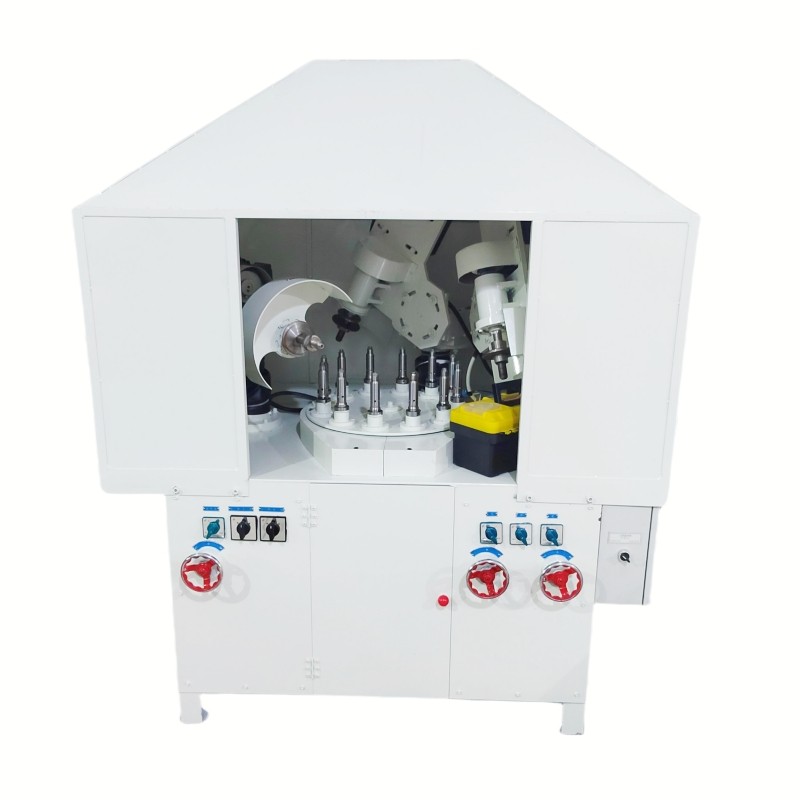
A rotary disc (turntable) polishing machine is an automatic multi-head polishing machine in which workpieces are clamped in fixtures mounted on a rotating table of chucks (also called collets). As the table turns or indexes, each part is carried past a series of polishing heads, each holding a buffing wheel loaded with a different polishing compound, so that a rough, medium and mirror stage are completed in one pass without the operator touching the part again. The number of heads is the defining specification: three heads suit a single, simple finish; four or more separate the cutting stage from the colouring stage and reach a true high-mirror surface in one cycle.
The idea is simple, and it is the same idea that makes CNC machining repeatable: remove the human hand from the process and replace it with a fixture and a program. On a rotary machine the table plays the role of the operator's arm — it moves every identical part past every wheel at the same angle, at the same pressure, for the same time. What varies between machines is not the concept but the arithmetic: how many chucks on the table, how many heads around it, and how large a wheel each head can carry.
Large flat panels are forgiving: there is plenty of surface to hold, and a mistake is easy to blend out. Small parts are the opposite, and four problems make them the natural home of the rotary disc machine.
They are hard to hold. A 30 mm case back or a decorative nut gives the operator almost nothing to grip, and gloves cost feel. A fixture solves this once, for every part that follows.
They overheat and burn. Small mass heats up fast, so the same pressure that is safe on a large panel will scorch a small one. Automatic pressure, oscillation and controlled wheel speed keep the heat where it belongs. Our article on eliminating surface burning and over-cutting covers why this matters more than any single machine choice.
They demand consistency. Cosmetic parts — watch components, jewellery, visible hardware — are bought on appearance, and appearance is judged side by side. Hand polishing drifts between shifts; a fixtured machine does not.
The cost per part is brutal by hand. A part that takes a minute by hand costs a minute of skilled labour every time. Once the machine is set up, an operator feeds parts and runs several machines at once, and the labour content collapses.
The one thing hand polishing cannot do
It is not that a skilled polisher cannot produce a mirror on a small part — it is that they cannot produce the same mirror on the ten-thousandth part, at the same cost, with the same operator, on the same day. Consistency at volume is the product a rotary disc machine actually sells.
3. Inside the machine: turntable, chucks, heads and fixtures
Every rotary disc machine is built from the same five systems. Understanding them is what lets you read a specification sheet rather than be impressed by it.
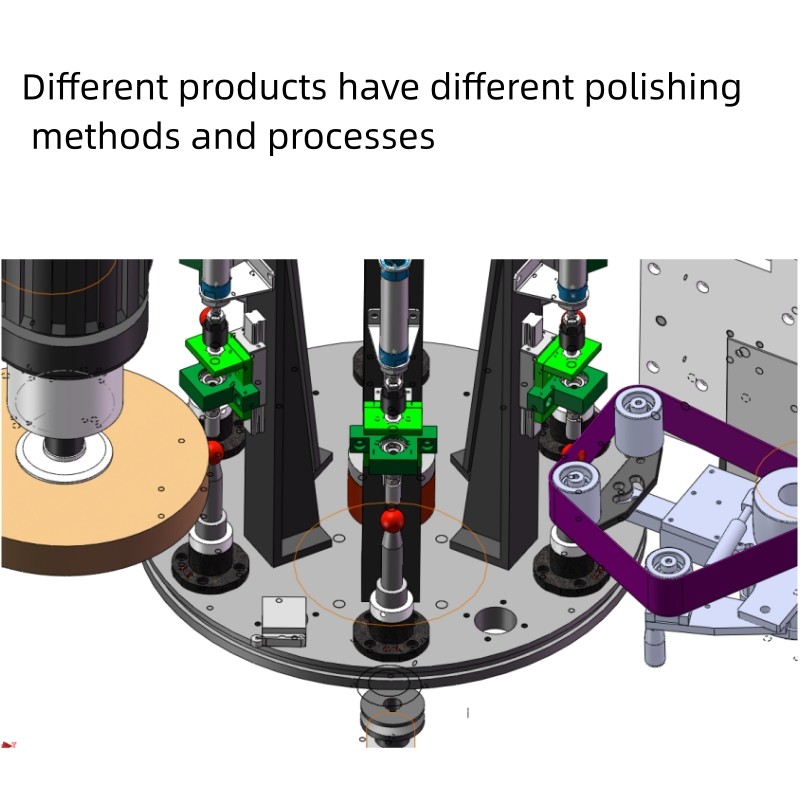
The turntable (disc). A circular table that indexes or turns continuously. On the machines in this family the large disc is typically 800 mm across, and on some models the disc is a working platform that can travel in and out as well as rotate.
The chucks (collets). The positions that carry the workpieces around the table. The standard arrangement is twelve chucks, and each chuck can rotate the part on its own axis while the table carries it in a circle — the machine's manual calls this double rotation, and it is what lets the wheel reach the whole surface of a round part rather than a single stripe.
The polishing heads. Each head is a motor-driven spindle carrying a buffing wheel. On our three-head turntable machine the wheels run at up to 2,800 rpm and up to 300 mm in diameter; the four-head model carries a 2.2 kW motor per head and up to 100 mm of usable wheel thickness. Heads can usually be fitted with optional variable-frequency drives so each stage can be tuned independently.
The fixtures (tooling). The part-specific holders that clamp each workpiece onto its chuck. This is the least glamorous and most important component on the whole machine — see section 6.
The control system. A microcomputer touch screen that sets chuck speed, wheel speed, oscillation, cycle count and pressure. Advanced machines add a fault self-diagnosis page that reports which sensor or servo has tripped, which is what keeps an unmanned cycle from turning into scrap.
The working principle, in one sentence, is the one written in the machine's own manual: a disc driven by the main motor carries twelve chucks in a circle while each chuck rotates on its own axis, and three — or four — high-speed polishing wheels polish the parts in sequence as they pass.
4. Three heads or four? Choosing the head count
Head count is the number that drives both the finish and the price, so it is worth deciding it from the part rather than from a preference for a larger machine. The table below is the decision we use with customers.
Heads
What it delivers
Suits
3
Cut, refine and colour in one continuous pass; a single consistent finish
Light stock removal and one finish requirement — watch case backs, small round parts, general bright finishing
4
Separates the cutting stage from the mirror stage, so the last wheel only refines; genuine high-mirror on the polished face
Cosmetic parts where the mirror is the product — watch cases and bezels, jewellery, visible hardware, small sanitary fittings
4 + belt head
A belt-grinding head removes stock and flattens, then polishing-wheel heads bring up the colour on the same table
Parts that arrive with tooling marks, edges to break, or a face that has to be levelled before it can be polished
5+ / twin table
More stages, or two independent stations running at once for higher output
High-volume lines and multi-stage cosmetic finishes, and watch bracelets or long parts needing wider coverage
Head count is decided by the part, not by the size of the budget. Adding a head later is a rebuild, not an upgrade — so settle it before you sign.
Two practical rules keep buyers out of trouble. First, if the part needs only to be bright and uniform, three heads are usually enough and cheaper to run; the fourth head earns its place only when the final gloss has to be flawless, because it lets the last wheel work on an already-refined surface rather than doing two jobs at once. Second, if the part arrives rough — with machining marks, a stamped edge or a welded joint — the answer is often not a fourth polishing wheel but a belt-grinding head ahead of the wheels, which is exactly why our machines are offered with a combined belt-and-wheel configuration.
5. The YL-APM-021 family: specifications
The machines we build for this job share one architecture and scale across part size and output. The two centre-pieces are the three-head YL-APM-021 automatic turntable machine and the four-head YL-APM-021-4; the same table-and-head logic extends to the single-station and dual-station watch and jewellery models below.
Model
Heads / station
Table & chucks
Wheel
Power
Capacity
Size · weight
YL-APM-021
3 heads, sequential
12 chucks; chuck 1–5 rpm; part 1,100 / 2,100 rpm
Ø300 mm · 2,800 / 2,100 / 2,100 rpm
8.1 kW
700–1,800 pcs/h
1600×1200×1800 mm · 800 kg
YL-APM-021-4
4 heads, sequential
12 chucks on an 800 mm disc; part 1,100 / 2,100 rpm
Multi-axis part spindle, 180°; slide travel 250 mm
Ø350 mm · 0–2,600 rpm stepless
7 kW
Watch cases, bracelets, bodies
1800×1750×2100 mm
YL-ATPM-021-6 / -7
Dual station (watch strap)
Servo-driven part rotation, 360°; slide 106 mm (up to 260 mm)
Ø350×230 mm · 0–2,600 rpm; stroke 0–50 mm
10 HP + VFD
Cases, bezels, edges, buckles
2350×1820×2160 mm crate
YL-ATPM-051
Single-axis rotary disc, enlarged platform
800×800 mm disc; 38 mm hex spindle; 45/90/180/360° indexing
Part spindle up to 1,800 rpm
12.17 kW
Flat, star and hinge-type parts
1680×1700×1520 mm · 1,600 kg
Figures are for the standard configurations; the exact head layout, wheel size, voltage and options are confirmed against your part. The -6 and -7 variants are the same dual-station watch-strap machine, without and with a dust cover.
Two details on the flagship machine repay attention. The four-head YL-APM-021-4 runs 2.2 kW of motor on each head and can carry wheels up to 300 mm diameter on a 25 mm shaft; optional inverters let each head hold its own speed, so the first head can cut hard while the last head runs fine and slow. And because the wheels are mounted on adjustable spindles, oscillation can be switched on where a fine finish needs it — a polishing wheel that sweeps across the part spreads its contact and avoids the swirl marks a fixed track leaves behind.
6. Fixtures are the real project, not the machine
If there is one sentence to take from this guide, it is this: you are not buying a machine, you are buying a fixture for your part, mounted on a machine. The machine is a platform; the fixture is the interface that decides whether the part is polished evenly, held securely and released without a mark.
A few consequences follow, and they are the reason quoting starts with a sample rather than a price list.
Fixtures are designed per part. A different workpiece usually means a different fixture, not a different machine. Tooling is quoted alongside the machine because it is part of the process, not an accessory.
Large parts reduce the usable chuck count. The standard table carries twelve chucks, but if the part is big the neighbouring positions are left empty so parts do not collide as the table turns. Twelve is a maximum, not a guarantee.
Holding method matters. Depending on the part, the fixture may clamp a bore, grip an edge, or hold a face; the choice protects both the finish and the part's dimensions.
The fixture is proven on your part. In a custom project we build and run the fixture against your own workpieces before delivery, because a fixture that looks right on a drawing can still mark, slip or under-polish in practice.
The same discipline extends to long, thin parts. The dual-station watch-strap machine, for example, uses a servo-driven rotating spindle so the workpiece can be turned and indexed accurately while the head oscillates overhead — hardware the operator simply could not coordinate by hand.
7. The wheel-and-compound pairing that makes the mirror
The machine moves the part; the wheel and the compound do the work. Every head is a chance to use a different combination, and the sequence across the heads is what turns a dull, marked part into a mirror.
Head stage
Wheel
Compound
Job
1 — Cut
Sisal / hemp, or an abrasive belt head
Strong-cut bar or roughing slurry
Remove tooling marks, stamped edges and coarse scratches
2 — Refine
Cloth / cotton wheel
Medium compound
Erase the first-stage scratches; the surface starts to brighten
3 — Colour
Soft cloth or loose-fold wheel
Fine or mirror compound
Bring up gloss without removing further metal
4 — Mirror
Fine cloth wheel
Mirror-grade compound
Deliver the final, uniform high-mirror on the polished face
Two material notes are worth carrying into any setup. On brass, copper or watch-alloy parts the goal at every stage is the mirror, not the cut, so go gentle and step the gloss up rather than chasing removal. On stainless and steel a sisal or hemp wheel can take a stronger cut first, and a light, low-residue compound on the finishing heads keeps wax out of the surface. If you are still choosing the compound, our guide to polishing compound and buffing wax selection sets out cut, gloss and grease head by head, and the polishing consumables and polishing cloth wheel categories carry the wheel side of the pairing.
Buy the consumables with the machine
A rotary machine is only as good as the wheels on it, and the wheels are a consumable that re-orders for the life of the machine. Sourcing the machine and the matching wheel-and-compound set from one supplier is the simplest way to keep the finish stable from the first batch to the hundredth.
8. Throughput and the payback maths
Capacity is quoted in pieces per hour, and it is worth checking the arithmetic against your own part before any quotation discussion. Three numbers decide it: the number of usable chucks, the number of table revolutions (or indexing steps) a full cycle needs, and the cycle time in seconds.
Worked example
Take a machine with 12 chucks where each part needs two table revolutions to complete the sequence, and a cycle of 40 seconds per revolution. In 40 seconds the table delivers 12 parts, so the output is 12 ÷ 40 × 3,600 = 1,080 pieces per hour — comfortably inside the 700–1,800 pcs/h rating of our three-head turntable machine. Change the part and the cycle time changes with it; change the fixture and the number of usable chucks changes. Run the sum with your own numbers rather than the headline figure.
The comparison that matters is against the bench. A skilled polisher finishing a small part by hand typically needs several tens of seconds per part, one part at a time. At a thousand parts an hour, one machine replaces that bench entirely — and because the operator only loads and unloads, one person can supervise several machines, which is where the real labour saving sits. Our articles on the five signs your operation is ready for automation and moving from manual polishing to machine grinding cover the point on the shop floor at which the numbers tip.
9. Which parts it suits — and real projects
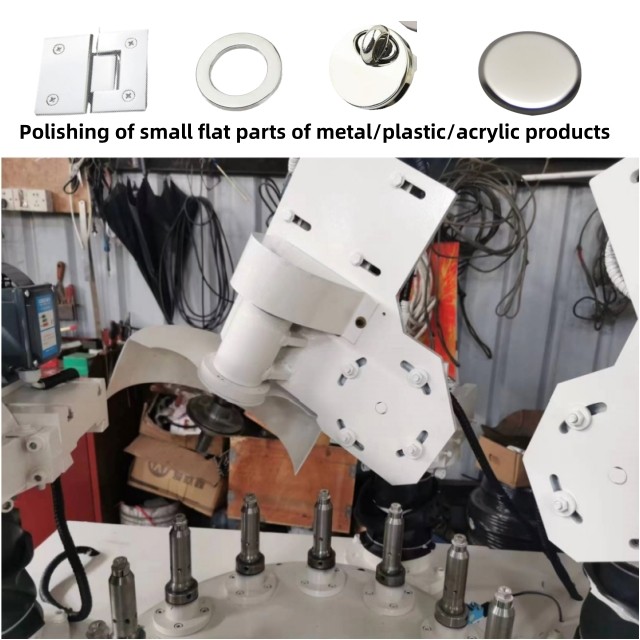
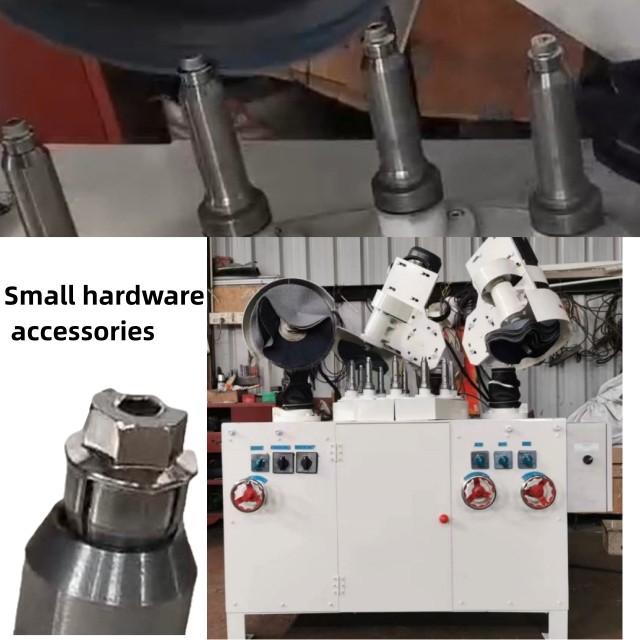
These machines were developed for small, high-value, appearance-critical metal parts, and that is still where they earn the most. The parts we build them for include:
Jewellery and metal accessories — rings, chains, clasps and small decorative parts.
Nuts and fasteners — surface polishing and deburring of nuts and similar small round metal products.
Bag, luggage and button hardware — clasps, buckles and fittings.
Electrical and 3C components — small parts whose appearance or surface condition matters.
Small sanitary-ware fittings and hardware accessories, and, on the single-axis platform model, flat, star-shaped and hinge-type parts.
The range of real jobs these machines go out on is wide. We have built big-disc turntable machines for watch and watch-bottom polishing, dual-station watch-strap machines and multi-head watch-case machines for makers in India, custom watch-band grinding machines for a buyer in Switzerland, rotary-table machines for door-hardware and hinge-type parts, and medal-polishing setups where the same fixtured logic is applied to a different small part. The common thread is not the industry but the part: small, numerous, appearance-critical, and impossible to keep consistent by hand.
10. Customization, OEM and your own-brand consumables
Machine Customization · OEM · ODM
A machine built for your part — and an own-brand consumable line to run on it
No two parts are the same shape, so no two machines leave the factory the same. On the machine we customize the number of heads, the fixtures and tooling, the wheel spindle and wheel size, the voltage and control, and options such as a dust cover and automatic waxing. On the consumable side, the entire line the machine runs on can be produced under OEM or ODM with your own branding:
Polishing wax and compound — private label with your own logo, weight, colour and carton
Cloth, sisal and nylon wheels to match each head's stage
Abrasive belts and discs for belt-grinding heads
Polishing brush heads and the other consumables in the finishing line
OEMYour logo, weight, colour and carton on the consumables
Full lineWax, wheels, belts, discs and brush heads from one supplier
This is where a machine sale and a consumable programme reinforce each other. A polishing machine is bought once every several years; the wheels and compound on it are bought continuously. A distributor who supplies both — the machine, and the own-brand consumables it runs on — captures the repeat purchase every month, and the customer gets one supplier accountable for the finish rather than a machine from one company and wheels from another. If you want a private-label compound to sit on the shelf beside the machine, the mould, weight and carton options are set out in our polishing compound guide; if you want a branded wheel and belt line, the same OEM and ODM support applies.
11. What to send us for an accurate quote
A rotary disc machine cannot be quoted from a category page: the configuration follows the part. With the following, a proposal, a head layout and a scheme drawing are usually possible without any back-and-forth — and if you can send physical samples, the fixture design becomes far more reliable.
A physical sample part (the single most useful item) — or drawings plus photos of the part and its current surface condition;
Part size and shape — diameter and thickness, and whether it is round, flat, or star / hinge shaped;
Material — stainless, steel, brass, copper, aluminium or watch alloy;
Faces to be polished — the top face only, or faces and edges; and whether any face must be levelled first;
Required result — bright uniform finish, or a specified high-mirror, and any burr or edge condition to meet;
Output required — pieces per hour or per shift that you must sustain;
Starting condition — how the parts arrive (stamped, machined, cast, laser-cut), which decides whether you need a belt head ahead of the wheels;
Shop constraints — footprint, power supply, existing extraction, and whether the machine runs as a standalone cell or inside a line.
12. Frequently asked questions
What is a rotary disc polishing machine used for?
A rotary disc polishing machine is used for the automatic, high-volume polishing of small metal parts that are awkward to hold by hand. Workpieces are clamped in fixtures on a rotating turntable and carried past three or more high-speed polishing heads, so a rough, medium and mirror stage are completed in one automatic cycle. Typical parts include watch cases, case backs, bezels and buckles, watch bracelets, jewellery, nuts and fasteners, button and bag hardware, electrical and 3C components and small sanitary-ware fittings.
How many polishing heads do I need: three or four?
Three heads are enough when the part needs one consistent finish and the stock to be removed is light: the first head cuts, and the next two bring up the colour. Choose four or more heads when you need to separate a heavier cutting stage from a fine mirror stage, when the part has more than one face or contour to polish, or when a single pass of the first wheel cannot remove the tooling marks. On a combined machine you can also fit a belt-grinding head and a polishing-wheel head, so grinding and mirror polishing happen on the same table. The head count is decided by the part, not by a preference for bigger machines.
Can one machine polish parts of different sizes and shapes?
Yes, within limits set by the fixtures and the table. The chucks hold the part through a dedicated fixture made for that workpiece, so a change of part usually means a change of fixture rather than a change of machine. A standard table carries twelve chucks; when the part is large the number of usable chucks is reduced so the parts do not collide. Because the fixture is the interface between the machine and the part, it is designed from a physical sample of your workpiece, which is also why we ask for samples before quoting.
What surface finish can an automatic rotary polishing machine achieve?
A correctly configured rotary disc machine takes small metal parts to a bright, uniform finish and, on a four-head setup with a proper wheel-and-compound sequence, to a genuine high-mirror surface on the polished face. The result depends on the metal, the starting condition of the part, the wheel on each head and the compound matched to it. Because every part follows the same fixture and the same heads, the finish is repeatable from the first piece to the ten-thousandth, which is exactly what hand polishing cannot deliver.
What is the production capacity of a rotary disc polishing machine?
Capacity is quoted in pieces per hour and depends on the number of chucks, the table speed and the cycle time the finish requires. Our three-head automatic turntable machine is rated at 700 to 1,800 pieces per hour for small round workpieces such as watch case backs. To convert that into a real figure, multiply the number of loading positions by the number of table revolutions the cycle needs, and divide by the cycle time; one operator can comfortably run several machines at that pace, which is where the labour saving comes from.
Can the machine and the consumables be customized, including OEM?
Yes. On the machine side we customize the number of heads, the fixtures, the wheel spindle and wheel size, the voltage and control, and options such as a dust cover and automatic waxing. On the consumable side the whole line that the machine runs on — sisal and hemp wheels, cloth and nylon wheels, polishing wax and compound, abrasive belts and discs and polishing brush heads — can be supplied under OEM or ODM with your own logo, weight, colour and carton. That lets a distributor pair a machine sale with an own-brand consumable programme that re-orders month after month.
Send us your part — we will tell you what the machine needs
Send a sample part, or a drawing with photos of its current surface condition, plus your material, the faces to be polished and the output you need. We will come back with a head configuration, a fixture design, a scheme drawing and a specification you can quote against.
Yi-Liang Polishing · 20+ years in polishing equipment & consumables · Exporting to 60+ countries · Machine customization & OEM supported
YL
Yiliang Polishing Engineering Team Written by the engineers at Guangzhou Qianma Technology Co., Ltd. / Yiliang Polishing — specialists in polishing machines, polishing lines and consumables, with more than 20 years of industry experience and a decade of export experience across Asia, Europe, Africa and the Americas. www.yl-polishing.com


 Pусский